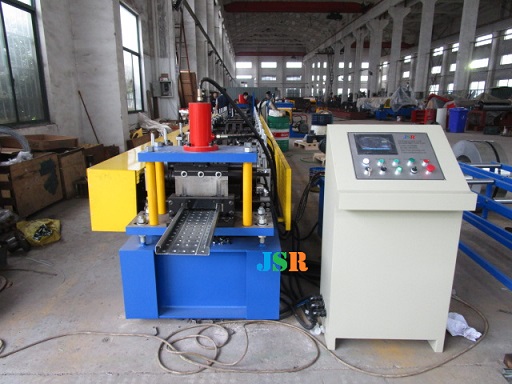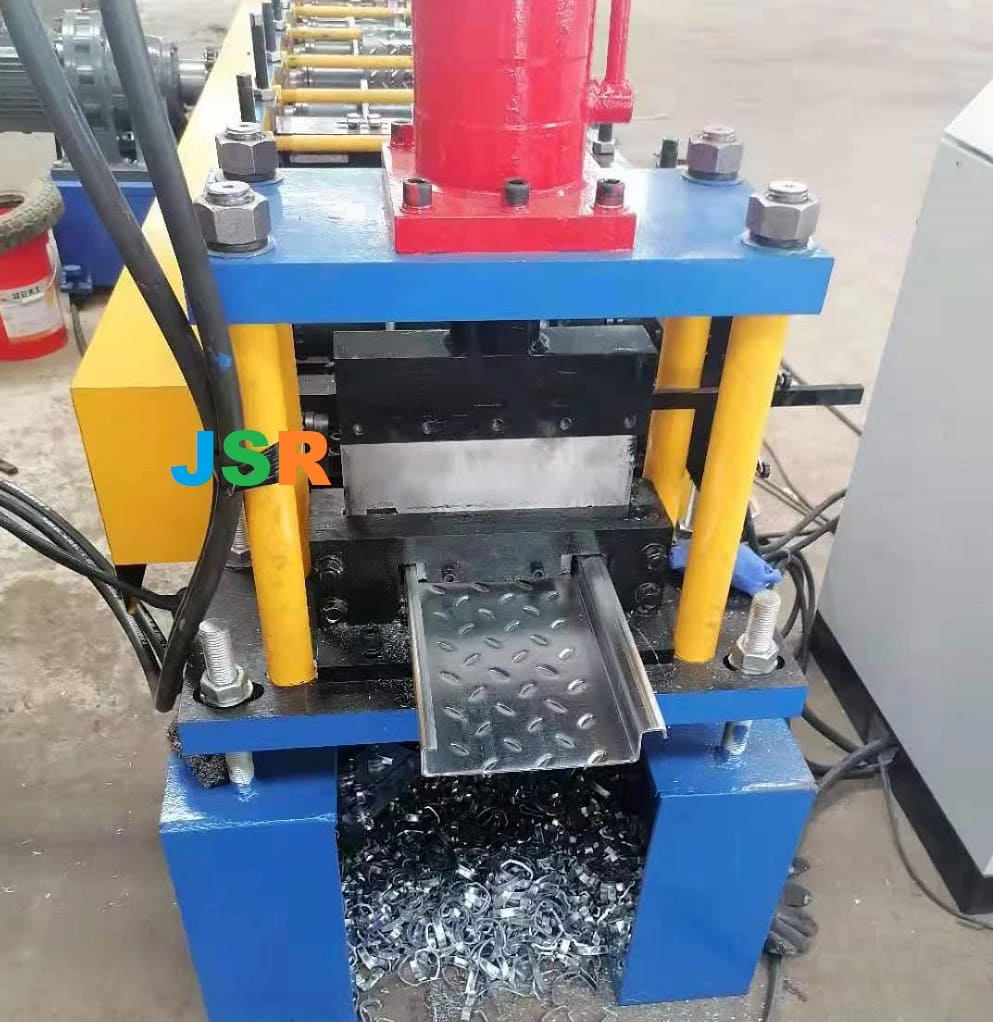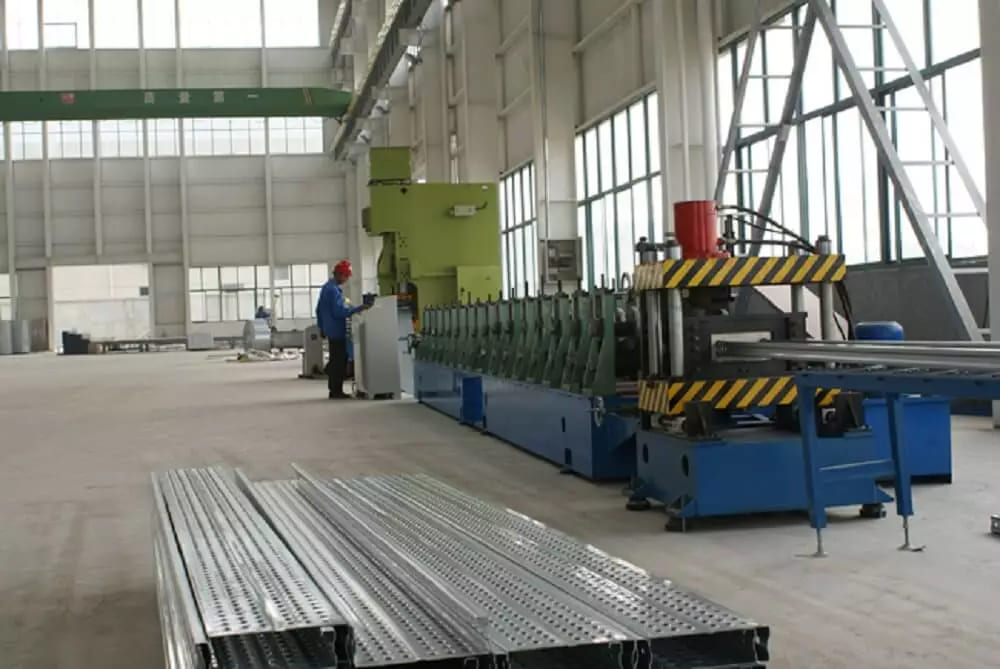

Improving the productivity of a scaffolding plank production line involves more than simply increasing the operating speed of the roll forming machine. Manufacturers must coordinate material feeding, punching, forming, cutting, quality inspection, and finished-product handling to achieve reliable output.
For companies producing galvanized steel scaffold planks, perforated walk boards, and metal scaffolding platforms, production efficiency directly affects manufacturing costs and delivery performance.
A properly configured scaffolding plank roll forming machine can help manufacturers reduce unnecessary downtime, improve dimensional consistency, and maintain stable production over extended operating periods.
However, common issues such as inaccurate punching, profile twisting, material deformation, and cutting defects can significantly reduce the number of acceptable finished planks.
This article explains how manufacturers can optimize a steel scaffold board manufacturing line, identify production bottlenecks, improve finished-product quality, and make better equipment decisions.
An efficient production line starts with understanding how every manufacturing operation affects the next.
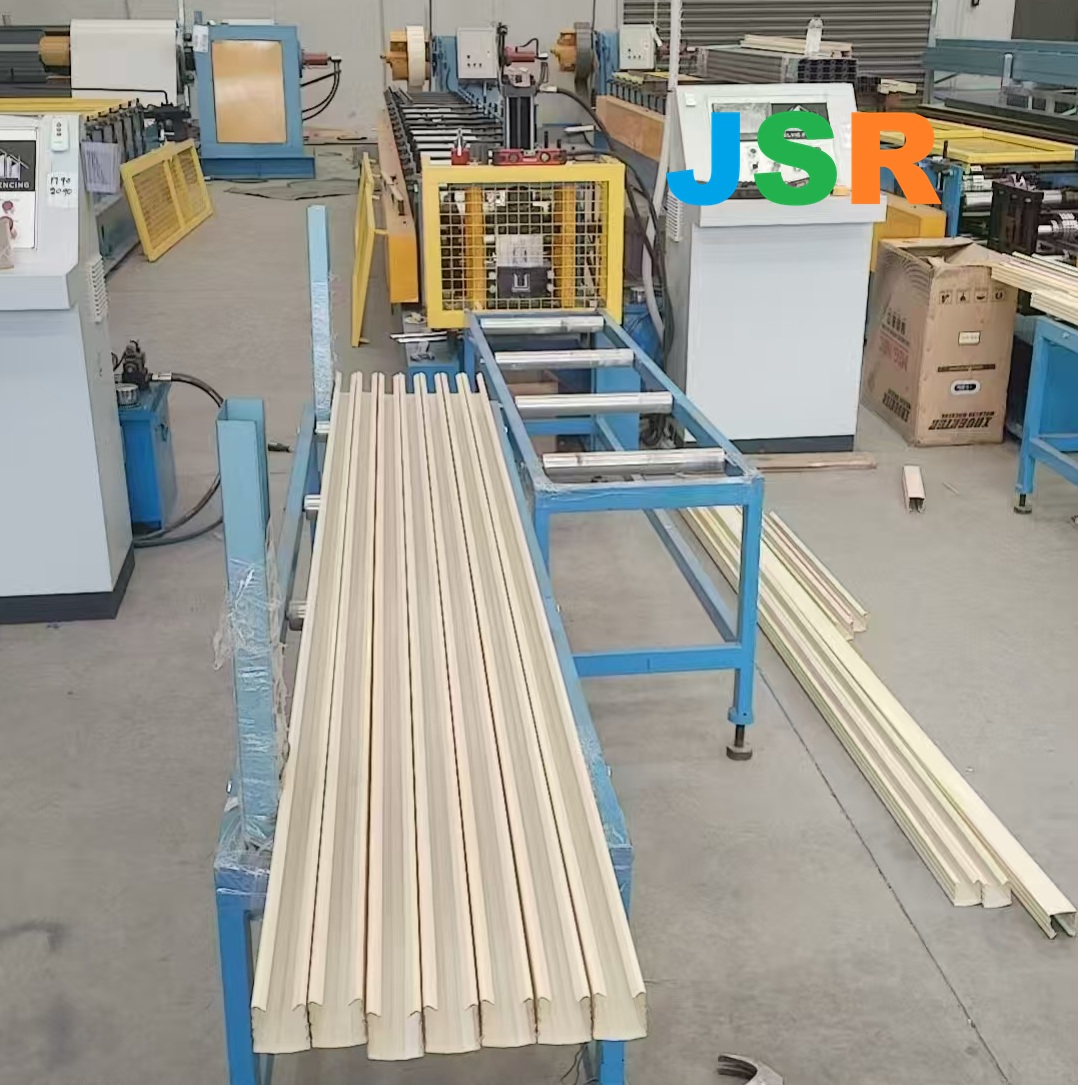
A typical steel scaffolding plank making machine follows this process:
Decoiling → Leveling → Punching → Roll Forming → Cutting → Inspection → Collection
Each stage has a specific function.
The decoiler supplies steel strip to the production line. Stable feeding is essential because irregular tension or poor strip alignment can affect downstream punching and forming accuracy.
Manufacturers should regularly inspect coil positioning, strip guidance, and material feeding consistency.
The leveling system helps prepare the steel strip before punching and forming.
Inadequate leveling may contribute to unstable feeding, uneven punching, and dimensional variation.
A perforated scaffolding plank machine may use hydraulic punching or mechanical press punching to produce required hole patterns.
This operation is particularly important when the finished board requires repeated drainage openings or raised anti-slip features.
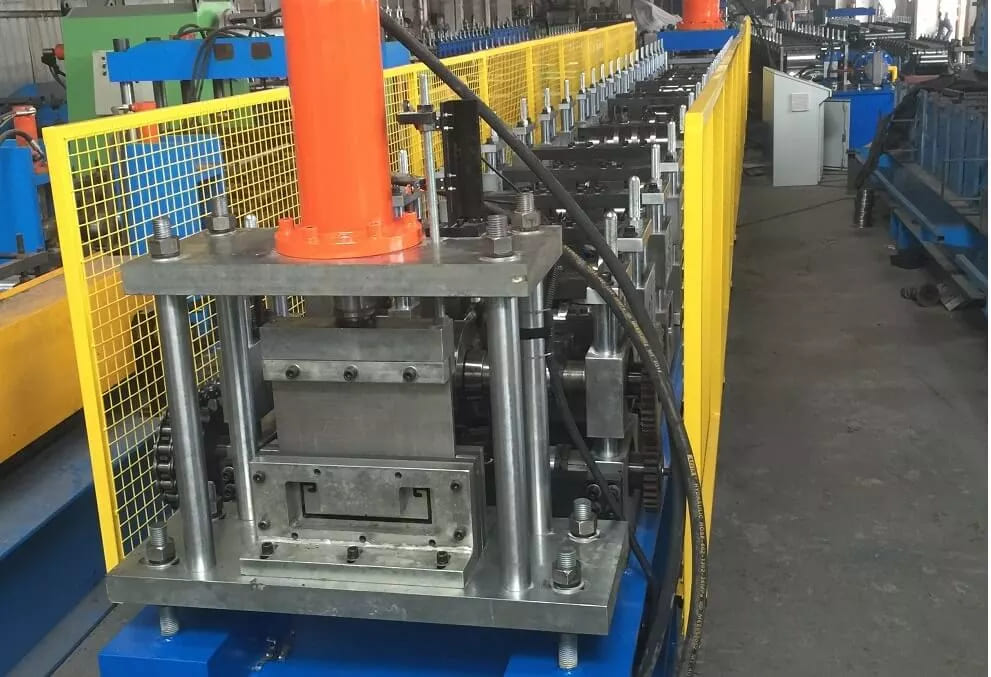
The forming section gradually shapes the steel strip into the required scaffold plank profile.
Correct roller alignment and appropriate forming progression help maintain consistent width, depth, and edge geometry.
The cutting unit separates the formed planks into predetermined lengths.
Finished products are then inspected and collected for further processing, assembly, or packaging.
A weakness in any of these stages can affect the productivity of the entire production line.
One of the most important principles in improving a scaffold plank roll forming machine is recognizing that the complete line can only produce as fast as its limiting operation permits.
A machine might have a forming-section capability of 10–15 m/min, but its practical finished-product output may be lower.
Typical bottlenecks include:
JSR Roll Former distinguishes between forming speed and actual production speed in its scaffolding plank equipment information.
For example, some hydraulic-punching configurations are described with working speeds around 4–6 m/min, while certain mechanical press arrangements may achieve approximately 10 m/min.
The appropriate production speed depends on the complete machine configuration and the customer’s actual plank design.
Manufacturers can evaluate each stage by recording:
This information helps determine whether investment should focus on a faster punching system, improved cutting, better material handling, or more reliable line adjustment.
Punching is often one of the most demanding operations in perforated steel scaffolding plank production.
Depending on the product design, steel scaffold planks may require a large number of regularly positioned holes.
The punching system must maintain hole accuracy while operating repeatedly.
The punching layout should be confirmed during machine design.
Important considerations include:
Changing the hole pattern after machine manufacture may require new punching dies or modifications to the production process.
Hydraulic punching and mechanical press punching have different strengths.
| Factor | Hydraulic Punching | Mechanical Press Punching |
|---|---|---|
| Initial investment | Often lower | Often higher |
| Punching cycle | Generally slower | Can be faster |
| Moderate-volume production | Suitable | Suitable |
| High-volume repetitive punching | Depends on configuration | Often advantageous |
| Tooling requirements | Application-specific | Application-specific |
| Maintenance needs | Hydraulic system and tooling | Press mechanism and tooling |
The best option depends on the number of holes, required production volume, and machine layout.
Worn or poorly aligned punching dies may produce:
Regular tooling inspection and replacement help maintain punching consistency.
For manufacturers operating a galvanized perforated walkway plank machine, attention should also be given to coating damage around punched areas.
Dimensional consistency is especially important because scaffold planks must fit their intended supporting systems.
A steel walkway plank roll forming machine should maintain the required profile geometry throughout production.
Typical dimensional concerns include:
Profile defects can result from several conditions.
Incorrect roller alignment: Improperly aligned forming rollers can introduce uneven deformation.
Inconsistent material properties: Variations in material thickness, yield strength, or incoming strip shape can affect forming behavior.
Unbalanced forming pressure: Excessive deformation at individual stations can contribute to twisting or surface marking.
Poor strip guidance: Incorrect entry alignment can affect the entire forming process.
Tooling wear: Worn rollers or guide components may gradually reduce profile consistency.
Manufacturers should establish a routine for checking the first acceptable plank after machine setup.
During longer production runs, dimensions should be verified at defined intervals.
When defects appear, operators should identify the relevant process condition before changing multiple machine settings simultaneously.
This reduces unnecessary trial-and-error adjustment.
Cutting quality can influence both product appearance and assembly compatibility.
A scaffolding plank forming machine may use hydraulic cutting or a specialized saw-cut arrangement, depending on the profile geometry.
JSR also describes saw cutting for certain customized scaffolding plank designs.
Uneven cutting edges: May result from blade wear, incorrect clearance, or poor workpiece support.
Incorrect plank length: May result from measurement errors, material slippage, or control synchronization problems.
Profile deformation near the cut: May occur when cutting force or tooling support is unsuitable for the formed shape.
Excessive burrs: May result from worn cutting tools or incorrect cutting conditions.
To maintain cutting quality:
Where a product requires specialized end geometry, cutting requirements should be included in the initial engineering design.
A machine that forms an accurate profile but cuts it incorrectly may still produce commercially unacceptable products.
Galvanized steel is commonly used in scaffold plank manufacturing because the zinc coating provides corrosion protection.
However, poor production-line adjustment can damage the coating.
Common causes include:
For a galvanized scaffold board production line, coating preservation should be part of routine quality control.
Keep rollers and guiding surfaces clean.
Inspect incoming coils for damage before production.
Avoid unnecessary friction between the material and the machine structure.
Use appropriate collection and stacking methods to reduce scratches and deformation.
Where punching or cutting exposes bare steel, confirm whether the finished product requires additional corrosion-protection treatment under the applicable product specification.
Production efficiency should be measured by the amount of acceptable finished output, not simply the number of meters processed.
A steel scaffold plank manufacturing machine may operate continuously, but excessive rejected products can eliminate the benefit of higher speed.
A practical inspection plan can include the following:
| Inspection item | What to check | Why it matters |
|---|---|---|
| Raw material | Thickness, grade, coating condition | Stable forming and specified material properties |
| Punching | Hole dimensions and positions | Assembly and surface requirements |
| Profile geometry | Width, depth, straightness | Product consistency and compatibility |
| Cutting | Length, burrs, end geometry | Installation and finishing quality |
| Surface condition | Scratches, coating damage | Appearance and corrosion resistance |
| End connections | Fit and geometry | Compatibility with scaffold system |
| Structural testing | Required load and deflection performance | Product safety validation |
Inspection criteria and tolerances should be established from approved drawings and applicable product specifications.
Steel scaffold planks are safety-related components. Dimensional inspection alone cannot establish their load capacity or suitability for a specific working platform.
Where relevant, manufacturers should arrange appropriate structural testing and compliance verification before supplying the products.
Unexpected equipment failure can interrupt production schedules and increase operating costs.
A preventive maintenance plan helps improve the availability of a scaffold plank roll forming production line.
Before production, operators should inspect:
Maintenance personnel should review:
Longer-term inspections should cover:
Maintenance schedules should follow the equipment manufacturer’s recommendations and actual operating conditions.
Steel material is a major operating cost for scaffold plank manufacturers.
Material waste may arise from:
Coil width should be determined from the finished profile drawing and the required forming allowance.
An incorrect starting width can affect both material utilization and finished dimensions.
Recording successful machine settings for repeat products can help operators reduce the number of trial pieces needed during future changeovers.
Instead of grouping all scrap into one category, classify rejected products by defect type.
For example:
This makes corrective action more targeted.
A well-managed steel scaffold board making machine can improve profitability through better material utilization even without increasing its maximum speed.
Factory capacity should be based on realistic operating conditions.
A manufacturer should account for:
Consider two production lines.
One machine has a higher advertised forming speed but requires frequent stoppages.
Another operates more slowly but maintains stable punching, cutting, and collection.
The second line may achieve comparable or better acceptable output over a complete shift.
Manufacturers can track:
Machine availability: The proportion of scheduled production time during which the line can operate.
Good-product output: The quantity or length of acceptable finished planks produced.
Scrap rate: The share of material or finished products rejected during production.
Changeover time: The time required to switch to another approved product specification.
Maintenance downtime: Production time lost due to equipment maintenance or failure.
These indicators provide a more accurate picture of performance than nominal forming speed alone.
An equipment upgrade may be appropriate when existing production capacity no longer meets customer requirements.
Common reasons include:
However, manufacturers should first identify whether the problem comes from equipment capability, tooling condition, maintenance, or workflow.
Replacing an entire line may not be necessary when the main issue can be resolved through tooling improvement or process adjustment.
For manufacturers requiring additional capacity, JSR offers scaffolding plank roll forming solutions with different punching and production configurations.
Start by identifying the slowest operation in the complete production cycle. For perforated steel planks, punching may be the principal bottleneck. Improving punching capacity, reducing unnecessary stoppages, optimizing cutting operations, and improving finished-product handling may increase throughput without compromising profile quality.
Forming speed describes the capability of the forming section under specified conditions. Actual production speed depends on punching, cutting, feeding, and other operations. For example, a roll former may be capable of higher strip movement speeds while the punching system requires intermittent operation.
Possible causes include material movement, incorrect feeding, worn punching dies, improper die alignment, and control-system synchronization problems. Operators should inspect the feeding and punching systems before changing other settings. A stable hole pattern is important for meeting the approved product specification.
Twisting can result from uneven forming deformation, poor roller alignment, unsuitable material conditions, or incorrect strip guidance. Improvements may include adjusting roller alignment, checking material specifications, and reviewing the forming sequence. Persistent problems may require tooling-engineering changes.
Mechanical press punching can offer faster repetitive punching in suitable applications. However, the actual advantage depends on hole density, tooling design, press capacity, and line synchronization. Manufacturers should compare demonstrated acceptable output rather than relying only on the punch mechanism’s theoretical cycle speed.
Daily pre-operation inspections are appropriate for critical items such as cutting tools, punching dies, guides, and safety devices. More extensive preventive maintenance should follow the machine manufacturer’s recommendations, operating hours, and observed wear. High-volume production may require more frequent checks.
Use the correct coil width, maintain stable profile dimensions, inspect punching tools, and verify cutting accuracy. Manufacturers should also record rejection reasons and identify recurring defects. Reducing scrap and setup losses can improve effective productivity without purchasing a faster machine.
Many PLC-controlled production lines support programmed length settings and quantity control. However, actual capability depends on the machine’s feeding and cutting configuration. Buyers should confirm the supported length range and accuracy during factory acceptance testing.
Surface damage can affect appearance and compromise the protective coating. Roller marks, scratches, and damaged coating areas should be evaluated against the required product specification. Where necessary, cut edges or damaged coating areas may require appropriate protection.
Load capacity should be established through appropriate engineering design, material verification, testing, and compliance assessment. A roll forming machine does not automatically certify the finished scaffold plank. Requirements depend on the intended scaffold system and the regulations or standards applicable in the destination market.
Not necessarily. Profitability depends on acceptable output, material waste, energy consumption, maintenance, labor, and customer demand. A machine operating reliably at a moderate speed may be more economical than a faster line with high scrap or frequent downtime.
Share your current plank drawing, material specifications, punching requirements, actual production speed, downtime records, and expected output. This information helps determine whether a new punching arrangement, customized forming solution, or larger-capacity machine would be appropriate.
JSR Roll Former provides equipment solutions for manufacturers producing steel scaffolding planks, perforated walkway boards, and customized steel platform profiles.
Its scaffolding equipment range includes configurations with hydraulic punching, mechanical punching, and customized forming or cutting arrangements.
For manufacturers planning a new production line or upgrading an existing operation, important considerations include:
By evaluating these requirements together, manufacturers can make more informed investment decisions.
Improving a scaffolding plank production line requires a balanced approach to productivity, accuracy, maintenance, and quality control.
The most effective production strategy is not necessarily to operate a steel scaffold plank roll forming machine at its maximum speed. It is to achieve stable production of acceptable finished planks with minimal downtime and material waste.
Manufacturers who optimize punching, forming, cutting, and inspection can improve operational efficiency while maintaining the quality required by their customers.
For businesses producing galvanized steel scaffolding boards, perforated steel walkways, and customized metal platform components, JSR Roll Former provides equipment options that can be evaluated against specific production requirements.
Explore JSR’s equipment: Scaffolding Planks Roll Former